Monday, November 15, 2010

Section 5-7 Proving special quadrilaterals

Hi fellow honors geometry students.  I made up my own mini proofs that have to do with the section we're learning and took pictures of them completed.  Make sure you comment on my blog at the bottom!


Here is proving a Rectangle using parallelogram with congruent diagonals implies rectangle.  Other ways to prove Rectangles include: a parallelogram with at least one right angle or a quadrilateral with all four angles are right.


Proving Rhombi
  • A parrallelogram with congruent consecutive sides
  • Diagonals of parrallelogram bisect 2 angles of the parallelogram
  • A quadrilateral with diagonals that are perpendicular bisectors.


That one's SO sloppy. my bad


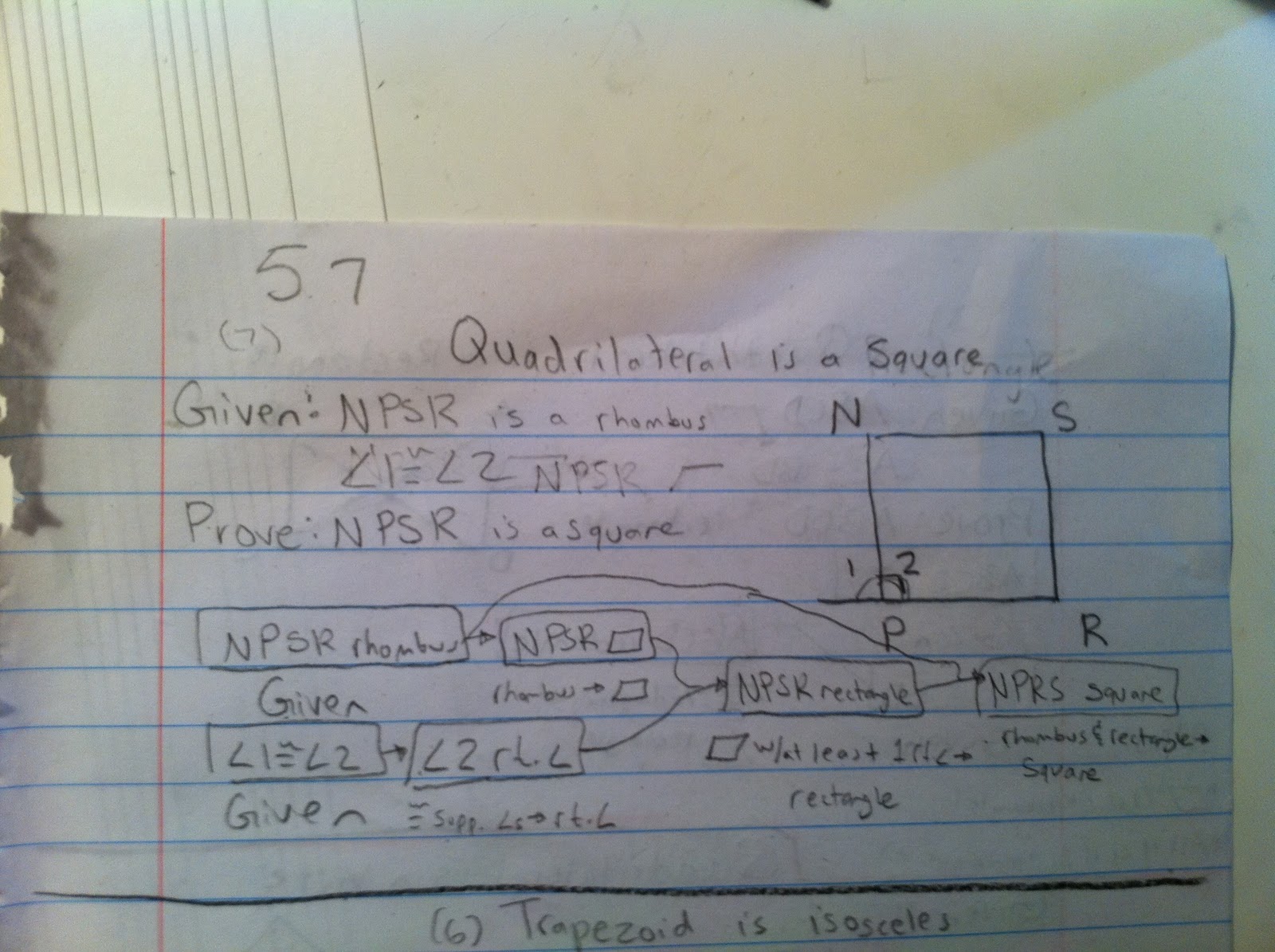
Proving Squares
There's only one way to prove a square: it's a rectangle and a rhombus.


Proving Kites
  • One diagonal is a perpendicular bisector (shown) 
  • A quadrilateral with 2 pairs of congruent disjoint sides.


Proving Isosceles Trapezoids

  • Trapezoid with congruent base angles
  • Nonparrallel sides of a trapezoid are congruent
  • Diagonals of a trapezoid are congruent


Alright, enjoy my blog!
-eLeni


i lost the game

Thursday, November 11, 2010

I Figured it Out

Hello, I’m David Mahoney.


Today in class we learned about what characteristics polygons have. All types of polygons need certain characteristics, but some have other features.


For instance…

Parallelogram – Definition:             Quadrilateral
2 pairs of parallel sides

HAS:             (what a parallelogram has but is not in the definition)
2 pair of congruent angles, all angles add up to 360*, diagonals bisect each other, congruent opp. sides, and supp. cons. angles

Rectangle – Definition:            Parallelogram (all the properties of a parallelogram apply to a rectangle), <1 rt. Angle

Has:            all rt. angles, 2 pairs of congruent sides, diagonals are congruent, congruent con. angles

Rhombus – Definition:            parallelogram, <2 cons. sides congruent

                                    Has:            all sides congruent, diagonals perp.

Square – Definition:                     parallelogram, rectangle, rhombus

                                    Has:            nothing special

Trapezoid – Definition:            Quadrilateral, exactly 1 pair of parallel sides

                                    Has:            corr. leg angles are supp.

Isosceles– Definition:                     trapezoid, non-parallel legs are congruent
Trapezoid
                                    Has:            congruent diagonals, congruent base angles

Kite – Definitions:            Quadrilateral, 2 disjoint pairs of consecutive sides are congruent

Has:            one diagonal perp. bis. the other, one diagonal is an angle bisector

Wednesday, November 10, 2010

Chapter 5.6

Any one of the following methods could be used in proving that quadrilateral ABCD is a parallelogram.


1. 2 pairs of parallel opposite sides
2. 2 pairs of congruent opposite sides
3. Diagonals bisect each other
4. 1 pair of opposite parallel and congruent sides
5. 2 pairs of congruent opposite angles
(5. all pairs of consecutive angles are supplementary)---rarely use 


This is pretty much chapter 5.6. Hope it helps!

--Elizabeth Quigley

Tuesday, November 9, 2010

Ch. 5.3 Congruent Angles Associated With Parallel Lines


Today in class we learned that parallel lines imply that certain angles have certain properties.


Parallel Postulate: Through a point not on a line there is exactly one parallel to the given line.


by looking at this diagram we can assume a number of things


Angle 3 is congruent to Angle 8: Parallel lines imply congruent alt. int. angles


Any of the angles are either congruent or supplementary


Angle 1 is congruent to angle 6: Parallel lines imply congruent alt. ext. angles


Angle 2 is congruent to angle 5: Parallel lines imply congruent corr. angles


Angle 3 is supp. angle 5: Parallel lines cut by transversal implies supp. same side int. angles


Angle 2 is supp. angle 6: Parallel lines cut by transversal implies supp. same side ext. angles

On the image on left: If any of those two lines are parallel and one of them is parallel to the third all three are parallel


Monday, November 8, 2010

Section 5.3 or something

Hey class. I did the blog post to get it over with. Anyways, we did some pretty interesting stuff.

For example, how to properly name a shape. Take, for example, this PENTAGON:


This pentagon could be named: ABCDE, AEDCB, and BAEDC. This pentagon could not be named: DACEB.
See the patterns? Self explanatory.

Then, we also learned the simplest definitions of shapes. I'll list them and their definitions here:

Quadrilateral: If and only if (Iff) four sided polygon

Parallelogram: Iff quadrilateral with parallel opposite sides

Rectangle: Iff parallelogram w/ at least 1 right angle

Rhombus (plural rhombi): iff parallelogram w/ at least two consecutive sides

Square: Iff a rectangle and a rhombus.

Kite: Iff quadrilateral w/ 2 pairs disjointed and consecutive sides

Trapezoid: Iff quadrilateral w/ exactly one pair of parallel sides

Thursday, November 4, 2010

5.1 and 5.2

Today in class (5.1) we learned about different arguments and proving something that is a not proof.
One argument is the direct argument. Its just the general:
p  q
p
                    
  q 
Another one is the transverse argument:

p  
q  r
                    
 p   r 
The last is an indirect argument.

p  
      q
                   
  q 

We then learned about how to prove a proof such as; 

Given: AD   CB
Prove: AD does not bisect CAB


When you have a proof that has the word not in it, you take it, and you assume the opposite. So, in this case, it said that AD doesnt bisect CAB which would mean that you would start your proof saying AD does bisect CAB. If your proof contradicts itself, then the statement is true. If it doesnt, the statement of which your supposed to prove is false.

Then we learned 5.2. 
Angle 2 is the adjacent interior angle and angles A and B are the remote interior angles.  Angle BCD is the exterior angle.  We learned that all triangles have 6 exterior angles but there are only 3 different measurements of the angles. So, we know that  m1 + m2= 180 degrees. We also know that mA + mB + m2 = 180 degrees. Knowing both of those, we can get that mA + mB + m2= m1 + m2. Therefore meaning that mA + mB= m1. So, m1 is greater than mA as well as mB.  
Lastly, we learned how to prove two lines parallel.  To do so, there are 7 theorems that you can use. ( ll means parallel)
1. alt. int. s -> ll          2. alt. ext. s -> ll  
3. corro. s -> ll    4. 2 lines  same line-> ll
                          5. sup. same side int. s -> ll        6. sup. same side ext.  s -> ll
                          7. two lines ll to same line -> ll

Friday, October 29, 2010

Terms
In order to understand the section, we must first understand the plane. A plane is a surface such that if any two points on the surface are connected by a line, all points of the line are also on the surface.
If points, lines, segments, and so forth lie in the same plane, they are coplanar. In the same way, if any of these do not lie in the same plane, they are noncoplanar.

Another term we need to be familiar with is transversal. A transversal is a line that intersects two coplanar lines in two distinct points.

In the diagram below, line n is the transversal. The region above line t and below line m is the exterior of the figure. The region between lines A and B is the interior of the figure.

Lines and Transversals create angle pairs. These angle pairs include: Corresponding Angles, Alternate Interior Angles, and Alternate Exterior Angles.
·         Corresponding Angles are a pair of angles formed by two lines and a transversal. One angle must lie in the interior of the figure and the other must lie in the exterior. The angles must lie on the same side of the transversal but have different vertices. Angle 1 and Angle 5 in the diagram above are examples of corresponding angles.

·         Alternate Interior Angles are a pair of angles formed by two lines and a transversal. Both angles must lie in the interior of the figure, must lie on alternate sides of the transversal and have different vertices. Angle 4 and Angle 6 in the diagram above are examples of alternate interior angles.

·         Alternate Exterior Angles are a pair of angles formed by two lines and a transversal. Both angles must lie in the exterior of the figure, must lie on alternate sides of the transversal, and have different vertices. Angle 2 and Angle 8 in the diagram above are an example of alternate exterior angles.
That should get us started on transversals and angle pairs,
thank you,
Ryan