Tuesday, February 8, 2011

12.4 Volume of Prisms and Cylinders

Hello fellow classmates, and teachers,
If you are unaware, or you were absent, or you didn't read the title, today we learned about volume. Below you will locate a written description and example sheet of volume and a video link. You may choose whichever suits you best. Mr Wilhelm, as you are aware I'm not here in first hour today. Knowing this would you be kind enough to show my classmates the hidden hint and puzzle for them to solve? If you would that would be very sincere, if not, well then I understand. Thanks, and Enjoy.

HINT: CONGRATS!!! After I tried so hard to hide this hint you still managed to process its whereabouts!!! If you would like to "LOSE THE GAME" then you must both read the blog and watch the video. Good Luck!

Volume: measures capacity

Volume: the amount of cubic units taken to fill a 3 dimensional figure


Sorry for any inconvenience, the "blach" was a B, I think the mic on my phone stalled out,
and the vibration noise was my phone ringing. It was the best take I had.


The equation for volume is represented by V=B(h)
With "V" representing volume, "B" representing the total area of the base of the figure, and "h" representing its height.

For example, the formula of a triangular prism: V= [1/2(bh)]H
rectangular prism: V=lwh
Cylinder: V=πr²(H)
and so on...

prism2.gifFC_Cylinder_41702_md.gif


Blog of the year?

Thank you for reading thy blog post, please subscribe,

I hope you enjoyed everything, for there is a possibility

that this may be my last blog post, (last trimester with Mr. Wilhelm)

Sincerely, Your loyal blogger, cough cough (Peter Kessel),


Oran Lieberman


P.S, the purple letters spell out, I LOST THE GAME.

Monday, February 7, 2011

Areas of Cones and Others

Okay so heres the problem we did in class in case you dont have it. We needed to fine the surface area for it. The formula for surface area is:
S= 2B + ph

All you have to do is take the numbers you already have and plug them into the formula.
Then.... 
Cylinders:
If you want to find the surface area of a cylinder, you use the formula that has been circled in yellow. It tells you what is needed to find the base and perimeter. 

And...
Spheres:
 The formula to find the surface area of a sphere is:            
And when you want the formula for a hemisphere, its easy to figure out. You cut the circle in half. Then, since you cut it, you added another circle (like a face) to it. It looks like, 

So, since you have half the cirlce, you divide the original formula in half. But, you have to add that new "face" in, so add one more area of a circle to that. You end up with,
And lastly...
Cones:

The surface area for a cone is, and the l means slant height if you dont have that.              

Theres also the Frustum of a cone. It looks like....
To find its surface area really isnt that difficult. All it is is
When the letters are big, it means from the big circle, and when they are small, it means the little circle.


I think thats about it, sorry if some pictures are a little confusing.

And just for fun, i lost the game :]

Kristy

Friday, February 4, 2011

Surface Area of Prisms and Pyramids

Hey class it's eLeni (5th last person to get the blog post)
Friday we learned how to find surface area of prisms, pyramids, and other irregular shapes that "make this honors geometry" as well as develop some formulas.

Mr.W starts with the example of a tissue box, which is a rectangle prism.
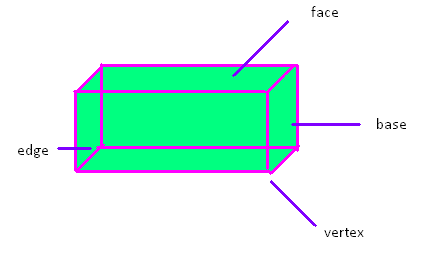
We review what faces, edges, and vertices are (in diagram).


We define Surface Area as the area of a surface. (Thank you, Shane)
Also, Polygon as a closed, straight-sided figure 
Polyhedrons are 3D figures with straight sides, faces, and is also a closed figure 
The Polyhedron shapes we will be learning about are Prisms and Pyramids
and the circular shapes are cylinders, cones, and spheres
Prisms  are polyhedrons with two congruent faces that are connected by rectangles
 Next, we learned Base which are the two parallel congruent faces (also in picture)
Lateral Faces  are the faces that are not bases (In our rectangular prism example, they are rectangles) 
Anti prisms  Prisms in which the lateral faces are triangles

Euler's Formula
This is pronounced "Oiler" (just so you don't sound like a fool in Mr. B's class)
To understand his formula, we made a chart of things we knew until we found some nice patterns.
  Rectangular Prism    Square Pyramid    Triangular Prism    Triangular Pyramid
F (Faces)           6                                5                        5                              4
V (vertices)        8                                5                        6                              4
E (Edges)          12                               8                        9                              6
We could then find these short formula/ideas
                  N-gonal Prism    N-gonal Pyramid
F (Faces)          n+2                     n+1
V (vertices)       2n                       n+1
E (Edges)          3n                        2n
I guess these are all just nifty things to know. Euler's Formula is F+V=E+2 (Variables same as chart)

Net-3D shapes are unfolded

This is a net of a Cube (A six-faces 3D shape of congruent squares)
Check out the net of a Cylinder:
It's really just a rectangle and two circles (faces)
This is the net of a cone.
*Notice that that is a circle and a sector
SURFACE AREA
1. Prism: S=2B+ph
          S=Surface Area, B=Area of base, p= perimeter of base, h=height
2. L=ph
           L=Lateral Area, P=perimeter of base, h=height
3. Pyramid: S= B+L 
         #3 is the most basic form of the formula, but can  be altered to be more useful

You can see that the L (Lateral Area) can be further broken up so that L= n (1/2 bh). This is the number of lateral faces which are triangle that have the area 1/2bh.  This formula is then simplified again to be  L=n (1/2 s) (l). l=slant height.
*Make sure the slant height is perpendicular to the base


HONORS GEOMETRY FUN
 The surface area for this interesting thing would be 
S=L(prism)+B(prism)+L(pyramid)
which can be simplified to S= ph+B+ 1/2 pl

*Remember that if you're finding them separately, the SA is not the SA of the pyramid+prism. This is because they share a common face
In this figure, a prism with square bases has been cut out of a rectangular prism.
Thus, S=L(big prism)+2B(big)-2B(small)+L
Or S=L(b)+L(s)+2(Bb+Bs)
This S happens to equal (2x+2y)z+(4a)z+2(xy+a^2)


I also found out where Mr.W got his cool 3D shapes!!!!
 
Adios, eLeni


Sunday, January 30, 2011

Law of SINES/COSINES

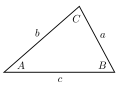
Fellow Classmates, Mr. Wilhelm, and Stalkers I Don't Know, Friday we learned A. the best way to make your math teacher happy is to hide all of their stuff B. that #A does not apply to Mr. Wilhelm C. #A is actually a letter D. stuff about shapes . . This beautifully color-coded picture illustrates an oblique trigon. Oblique trigons are sad because everyone groans when they see them because their measurements don't do any thing special. "Oh how I wish I could be a SPECIAL triangle!" said a young triangle. One day, Mr. Wilhelm invented a formula for them called THE LAW OF SINES . You plug in an angle (A), the side opposite it (a), and one other piece of information (angle C or side c). You can then solve for the other piece's counterpart (side c or angle C). You (and the triangles) can consider it something of a hero. . . This formula happens to be THE LAW OF SINES don't crowd it . . This is the same triangle from before. Cheap Budget. . . These formulas make up the LAW OF COSINES. The formulas on the left work when you are given SAS. The formulas on the right work when you are given SSS. . . . Here is a website that proves the law of sines Here is a website that proves the law of cosines Here is a website that exemplifies stuff Watch the video about sines and cosines It dosen't work.. but it shows the importance of apologies and good pouty faces Here is an unrelated website . . 'sine' ing off ~~OLIVIA MILLER~~

11.8 Hero's and Brahmagupta's Formulas

Section 11.8 was about Hero's and Brahmagupta's Formulas. Also, we learned an equation for the area of a triangle when SAS is given. 


SAS


Hero's Formula-(for area of triangles)


where a, b, and c are the side lengths


Brahmagupta's Formula-(for CYCLIC quadrilaterals ONLY)


where a, b, c, and d are the side lengths


Well, Hero and Brahmagupta were math geniuses, but they will never be able to top the great Mr. Wilhelm.


God Bless Blog Posts
(and the game)

Joey


Wednesday, January 26, 2011

11.7

Hey guys. This was an easy section. Yeah.

One was of determining the ratio of the areas of two figures is to calculate the quotient of the two areas.

As in, lets say a triangle has a height of 8 and a base of 12. And yes, I'm way too lazy to actually find a picture or draw one that corresponds to this. And theres another figure, a parallelogram with a height of 9 and a base of 12.

Everyone here should know the formulas for these areas, but in case you needed to be reminded:
A of Triangle= 1/2BH, where B=Base and H=Height
A of Parallelogram= BH, where B=Base and H=Height

So, if you wanted to compare area of the Parallelogram to the area of the triangle, you would first find the area of the parallelogram and then divide it by the area of the triangle.

A of Triangle= 1/2(8X12)=48
A of Parallelogram= 10X9= 90
which would be 90 over 48, and that simplifies to 15 over 8, or 15:8

One theorem we discussed in class is theorem 109, which states:
If two figures are similar, then the ratio of their areas equals the square of the ratio of corresponding segments. (Similar-Figures Theorem)

In other words, its basically this:

A1/A2=(S1/S2) squared.
where A1 and A2 are areas and S1 and S2 are measures of corresponding segments.

Another theorem we learned in the bum rush that is the end of class is Theorem 110, which states:
A median of a triangle divides the triangle into two triangles with equal areas.

In other words, Imagine a triangle PQS, nothing special about it.
Then, imagine a line from vertice P to seg. QS. The line bisects the segment at point R.
This theorem states that the Area of triangle PQR is = to the Area of triangle PRS

Imagination is better than knowledge. Or pictures. Or something.

http://artists.letssingit.com/daft-punk-lyrics-digital-love-6xcgscc
Last two lines are the best lyrics ever, by the way.

Tuesday, January 25, 2011

Chapter 11.6

Areas of Circles, Sectors, and Segments.


So friday in class we learned about sectors, segments, and ares of circles.

The area of a circle: A = Pi times r squared
sector of a circle is a regioun bounded by the two radii and an arc of the circle.

Area of sector: A=(m/360)πr2
*where m=measure of arc

OR

A segment of a circle of a circle is a region bounded by a chord of the circle and its corresponding arc.  
The yellow part above is the segment of the circle.
AB is the chord.
To find the segment of a circle= area of the sector-area of triangle AOB. That is the easiest way. In fomula way, A=(m/360)πr2 -(1/2)bh
Where m=measure of arc AB and bh is base times height.

That's all we learned on Friday, pretty easy. Sorry it's posted so late!
-Elizabeth (lost the game) Quigley