Sorry for the late notice, everybody. I'm canceling the quiz. We really need to have a test on Friday, so there's no room in the schedule to postpone it. I hope you're not too disappointed.
Please spread the word.
-Mr. Wilhelm
p.s. -- The assignment from 8.5 is still due tomorrow.
Monday, December 13, 2010

Sunday, December 12, 2010

Saturday, December 11, 2010
8.5: Three Theorems Involving Proportions
Hi everyone! Today in class, we learned three new theorems.
First is the side-splitter thereom:
side-splitter: a line in a triangle that is parallel to one side and intersects the two other sides


corollary- a thereom that is a direct result of a previous one
First is the side-splitter thereom:
side-splitter: a line in a triangle that is parallel to one side and intersects the two other sides

Proportion:

Next is the theorem with parallel lines:
If three or more parallel lines are intersected by two transversals, the parallel lines divide the transversals proportionally.

Proportion:

The last thereom is the angle bisector thereom:
If a ray bisects an angle of a triangle, it divides the opposite side into segments that are proportional to the adjacent sides.

Other:
corollary- a thereom that is a direct result of a previous one
That's all! Hope you liked the blog!
~Natalie
Thursday, December 9, 2010
Sections 8.1 and 8.2
Hey guys! Sorry this didn't go up yesterday, hope you didn't have to much trouble on the homework...
Also, heres a funny video about ratios if you watch it all the way through. Ratios: Bad Date
After your done reading, Click here for a new video from the makers of one dozen monkeys!
8.1: Ratios and Proportions
First of all, let's start with some basic definitions that boil these concepts down.
Ratio: Comparison of two numbers (Using fraction or colon).
Example: 5:6 or 5/6
Proportion: Setting two ratios equal to each other.
Example:

Theorem 59: In a proportion, the product of the means is equal to the products of the extremes.
ad=bc
This theorem uses basic cross-multiplying to simplify proportions.
Other theorems summed up to the following simple equations:


And also, an unexpected, yet true statement,

One last portion of this chapter included a new concept: arithmetic and geometric means.
The arithmetic mean of two numbers is found using the following equation:

While on the other hand, the geometric mean of two numbers is found using this equation:

That concludes Section 8.1.
8.2: Introduction to Similarity
In simple terms, similar figures are figures that proportionally have the same shape, but are not necessarily the same size.
In order for two polygons to be considered "similar", the must have one of two basic qualities:
-All corresponding angles congruent
-All corresponding side lengths are proportional

Some other terms that were also mentioned in the book were:
Dilation: An enlarged figure that is similar to the original figure.
Reduction: A figure reduced in size that is similar to the original figure.
This problem shows an example of a common problem which ties in similar figures, ratios, and proportions.

Another theorem that was also briefly mentioned in the book is as follows:
Theorem 61: The ratio of the perimeters of two similar polygons equals the ratio of any pair of corresponding sides.
This means that if, for example, the perimeter of an original square is 20 units, and the perimeter of the dilation of the square is 40 units, than the ratio of the perimeters as well as the ratios of corresponding sides should be equal.
That is about it for today's information! Thanks, and hoped it helped!
Juliaaaaaaa
Also, heres a funny video about ratios if you watch it all the way through. Ratios: Bad Date
After your done reading, Click here for a new video from the makers of one dozen monkeys!
8.1: Ratios and Proportions
First of all, let's start with some basic definitions that boil these concepts down.
Ratio: Comparison of two numbers (Using fraction or colon).
Example: 5:6 or 5/6
Proportion: Setting two ratios equal to each other.
Example:
| <----That form will be the basis for all the properties discussed below. | |||||||||||
| Oh, and also here are two necessary definitions. |
| |||||||||||
| Extremes: First and fourth terms (a and d) |
| Now that we have the basics out of the way, let's talk about some of the properties of proportions. |
Theorem 59: In a proportion, the product of the means is equal to the products of the extremes.
ad=bc
This theorem uses basic cross-multiplying to simplify proportions.
Other theorems summed up to the following simple equations:
And also, an unexpected, yet true statement,
One last portion of this chapter included a new concept: arithmetic and geometric means.
The arithmetic mean of two numbers is found using the following equation:
While on the other hand, the geometric mean of two numbers is found using this equation:
That concludes Section 8.1.
8.2: Introduction to Similarity
In simple terms, similar figures are figures that proportionally have the same shape, but are not necessarily the same size.
In order for two polygons to be considered "similar", the must have one of two basic qualities:
-All corresponding angles congruent
-All corresponding side lengths are proportional

Some other terms that were also mentioned in the book were:
Dilation: An enlarged figure that is similar to the original figure.
Reduction: A figure reduced in size that is similar to the original figure.
This problem shows an example of a common problem which ties in similar figures, ratios, and proportions.
Another theorem that was also briefly mentioned in the book is as follows:
Theorem 61: The ratio of the perimeters of two similar polygons equals the ratio of any pair of corresponding sides.
This means that if, for example, the perimeter of an original square is 20 units, and the perimeter of the dilation of the square is 40 units, than the ratio of the perimeters as well as the ratios of corresponding sides should be equal.
That is about it for today's information! Thanks, and hoped it helped!
Juliaaaaaaa
Sections 8.3 and 8.4
So today we learned how to prove that triangles are similar.
The 3 ways are:
AA~
SSS~
SAS~
When proving triangles congruent we had also learned ASA, AAS, and HL. But these are uneccessary for proving triangles similar because in each of these you already have some form of the first 3.

With the 2 triangles to the left we cannot prove them similar, because we do not have AA~, SSS~, or SAS~.

With these two triangles we can prove them similar using AA~.
The same principles apply to SSA~ and SSS~. Although you need to always remember that in order to prove similar the angles you use must be congruent, but the sides must be proportional.
I won the second game. Curse you blog post.
Big Money!.... that was for you Joey
Ah isn't math fun?
-Andrew
Thursday, December 2, 2010
Sections 7.3 and 7.4

So today we did section 7.3 and 7.4, which are all about formulas involving polygons.
Lets start with 7.3
So Each polygon has a unique name (until you get up really high)
Sides: Polygon
3 Triangle
4 Quadrilateral
5 Pentagon
6 Hexagon
7 Heptagon
8 Octagon
9 Nonagon
10 Decagon
12 Dodecagon
15 Pentadecagon
n n-gon
Each polygon has a certain number of diagonals. These are formed when you connect different vertexes to eachother (except ones that form the outer edge of the shape)
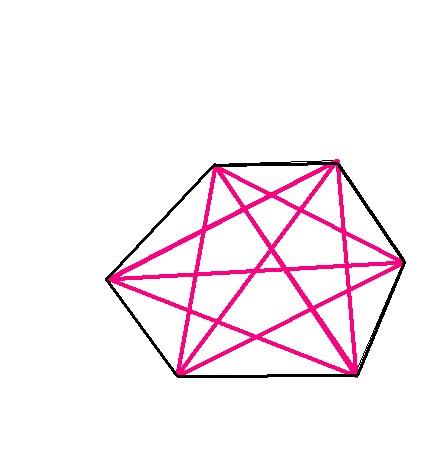
The pink lines are the diagonals of this hexagon
The number of diagonals in a polygon can be found using
n(n-3)
# of diagonals= 2
(where n is the number of sides in the figure.)
You can also find the measure of all of the angles in a polygon using this formula:
sum of the angles= (n-2)180
This works because you can divide the shape into triangles with each triangle equaling 180 degrees.

See the triangles?
<---------------
The sum of the exterior angles of any polygon will ALWAYS be 360 degrees.

This is because if you start at one angle and slowly rotate around to the next angle, and the next and the next, you will have made a whole circle when you get back to the first, or 360 degrees!
We also learned a formula that isn't in the book, which is to find the measure of one angle of a shape with a certain number of sides.
180n-360
measure of one angle in an n sided polygon= n
Now for section 7.4
Section 7.4 focused on regular polygons. Here are examples of a few:

Regular Polygon- a polygon that is both equilateral and equiangular
They also showed some equiangular polygons, which are like regular ones but they dont necessarily have all sides congruent. (like a rectangle.)
A formula to find the measure of any exterior angle of an equiangular polygon:
360
measure of the exterior angle= n
And that was really all that we learned!
Random Math things:
NONAGON SONG! (click on it!)
Hope you liked the blog!!!!!!!!!!!
:) Katie
Wednesday, December 1, 2010
Chapter 7: 7.1 and 7.2
12.1.10
- 7.1 Triangle Applications Theorems
- 7.2 Two Proof-Oriented Triangle Theorems
7.1
3 new theorems
- The sum of the measures of the 3 angles of a triangle is 180⁰

This can be proven using the parallel postulate, saying that line M is parallel to NS, and measure 180⁰, being a straight line and all. Like Mr. Wilhelm demonstrated for us in class, when the three angles are lined up along that straight line they complete the 180⁰.

2. The measure of any exterior angle is equal to the sum of the measures of remote interior angles.

http://schoolwires.henry.k12.ga.us/4376205615266500/blank/browse.asp?A=383&BMDRN=2000&BCOB=0&C=66757
An exterior angle is formed by extending on of the sides to form an angle that is exterior to the polygon and is supplementary to its corresponding interior angle. It is, by definition, adjacent and supplementary to an interior angle of the polygon.
Since all the angles of a triangle add up to 180⁰, then any interior angle is supplementary to the two other angles combined. And if the exterior angle is supplementary to the interior angle, then by a loose use of the transitive property the exterior angle must be equal to the two remote interior angles.
3. The segment joining the midpoints of two sides of a triangle is parallel to the third side and its length is one-half the length of that third side.

7.2
2 new theorems
1. If two angles of a triangle are congruent to two angles of a second triangle, then the third angles are congruent. (No-Choice Theorem)
Proof: since the sum of all the angels must equal 180, the sums must be set equal to each other. If we then apply the Subtraction Property, we see that the last two angles must be equal, and therefore congruent
DISCLAIMER!!!: the two triangles need not be congruent for us to apply the No- Choice Theorem.
Also, can be written ass AA→ AAA
2. Proving AAS. If two angles and one side, not between those two angles, are all congruent between triangles, then the triangles are congruent.
This can be proven using the No- Choice Theorem to say first that each pair of angles is congruent, then that the third angle is congruent, then that the sides are congruent. Technically its AAA or even ASA, but it’s one less step to say AAS.

And thats what we learned today! homework was:
7.1: 9,12,15-19
7.2: 18
blessings, Em J
Subscribe to:
Posts (Atom)