Wednesday, September 29, 2010

2-6 Multiplication and Division Properties

Today in class we learned about multiplication and division theorems.


Two important theorems are:

1.  if segments (or angles) are congruent, then their like multiples are congruent

2. if segments (or angles) are congruent, then their like divisions are congruent  (shown below)


Next, we proved one of the theorems:
                       ~                                                                                              ~          
Given:     AB   =   CD                                                               Prove:    AM   =  CN
                                   
               M midpt. AB
                                   
               N midpt. CD
This is the flow proof (sorry it's a little blurry):


Using the Multiplication and Division Properties in Proofs:

~ Look for double use of word midpoint or trisect or bisect
~ Multiplication property is used when the segments or angles in conclusion are greater than those given in the info
~ Division property is used when the segments or angles in conclusion are smaller than those given in the info


So thats what we discussed in class today
Hope it helped,
Natalie U.

Monday, September 27, 2010

Congruent segments theorem

The congruent segments theorem states that if the same segment is added to 2 congruent segments, then the resulting segments will also be congruent.
    
           A ___________________________B
                             C                    D

If AC is congruent to DB, then AD must also be congruent to CB for the reason that you are adding the same segment to congruent segments. This is easily represented by the Addition Property of Equality;

if AC= 2, DB= 2, and CD = 5, then that must mean that AD= AC+CD, which substituted in makes AD= 7
You can also see that for the same reason CB = 7, which means that AD and CB are congruent. No matter what the lengths of the lines are, if AC and DB are congruent, when CD is added, they will still be congruent. Also, if anybody reads this, it took way too long because my cat thinks the keyboard is a pillow.

Tuesday's quiz

Hello everybody,

Due to Thursday's modified schedule, I will be available during X-block tomorrow morning.

-Mr. Wilhelm

Sunday, September 26, 2010

Section 2.4


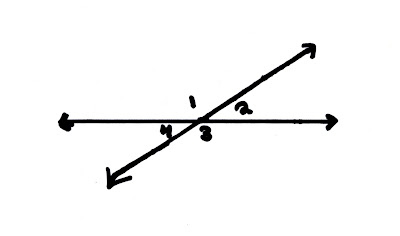
On Friday we learned about the congruence supplementary theorem.
Given:
1 and 2 are supplementary
2 and 3 are supplementary
3 and 4 are supplementary
4 and 1 are supplementary

You can conclude:
1 3
2 4

You can also conclude this with complementary angles.

Saturday, September 25, 2010

Quiz Tuesday!!

We'll be having a QUIZ (through section 2.4) on Tuesday. 
Spread the word.

Have a good weekend.

-Mr. Wilhelm

Thursday, September 23, 2010

Section 2.2

Today in class we learned about;
-Complementary
-Supplementary

Two angles are complementary if and only if their overall sum is equal to 90'.


Two angles are supplementary if and only if the overall sum of the angles is equal to 180'.


You can also show complementary and supplementary angles with proofs;


Thats what we learned in class today and i hope it helps. -Tyler Rogers


if the video doesnt work sorry if it doesnt work click on the link below
http://www.youtube.com/watch?v=EFHQOosKHFA

Wednesday, September 22, 2010

Section 2.1

Hi! Today's section was on perpendicularity.
perpendicular- lines, rays, or segments that intersect to form right angles
intersect- having at least one point in common. (though the intersection may not be labeled as a point)

__       __
AB _I_ CD
This means line AB is perpendicular to line CD. Sorry the perpendicular sign is a bit rough. It should look like this:

*The relationship "is perpendicular to" is symmetrical! (but not reflexive or transitive)*


You can NOT assume perpendicularity from a diagram.


                         As you can see, these lines appear perpendicular. However, because there is no indication that they are, you can not assume anything!
                           This is the exact same picture as before, except now there is a square to indicate a right angle, meaning that these lines definitely are perpendicular!
A couple more things about perpendicular lines:
Perpendicular --> RIGHT ANGLES, not 90 degrees!
2 lines are perpendicular IF AND ONLY IF (<-->) they intersect to form right angles.
If 2 lines intersect and DONT from right angles, they are not perpendicular.

Lastly, we talked about a few important fromulas for the coordinate plane.
First was the slope formula:


This can also be decribed as rise over run or delta y over delta x
Perpendicular lines have oppsite slopes such as y=-2x and y=1/2x

The next formula was the midpoint formula, which is:
or the average of the x coordinates over the average of the y coordinates

The final formula was the distance formula:
Here are some facts about horizontal and vertical lines:
horizontal line:
slope: 0
equation: y=a

vertical line:
slope: undefined
equation: x=b

And thats what we learned! Sorry for the rough pictures, I couldnt figure out the fancy math helper thing...
Bye! Katie <3