Thursday, March 3, 2011

Chapter 10.6: More Angle- Arc Theorems

Congruent Inscribed and Tangent- Chord Angles

Theorem 89:    If two inscribed or tangent- chord angles intercept the same arc, then they are congruent. 


Theorem 90:    If two inscribed or tangent- chord angles intercept congruent arcs, then they are congruent. 

Angels Inscribed in Semicircles


Theorem 91:    An angle inscribed in a semicircle is a right angle.

A Special Theorem about Tangent- Tangent Angles
In this picture, the measure of <P + the measure of arcAB = 180 

Theorem 92:    The sum of the measures of a tangent- tangent angle and its minor arc is 180o

That’s what we learned yesterday, paired with homework assignment 5:
10.6:    8, 9, 11, 15- 17, 24
10.7:    5, 7, 9, 10, 12, 15, 21

Blessings,
ErinJacs (alias book licker???)
oh, and BTW, today, because you guys are all so great, i will do everything in my power to prevent you from losing THE GAME

Tuesday, March 1, 2011

10.5 Angles Related to a Circle!

Hi! Today in class we learned about angles related to circles.
Here are the theorems!


  The first theorem has to do with inscribed angles.The measure of an inscribed angle (vertex of a circle) is one-half the measure of its intercepted arc.                                                  1/2a=x 


Next we have a chord-chord angle        The meaure of a chord-chord angle is one-half the sum of the measures of the arcs intercepted by the chord-chord angle and its vertical angle    
x=1/2(a+b)
 The next angle is a tangent-chord angle.     The measure of a tangent-chord angle is one-half the measure of its intercepted arc.
1/2a=x
 This is a secant-secant angle.  The measure of a secant-secant angle is one-half the difference of the measures of the intercepted arcs.
x=1/2(a-b)


Now we have a secant-tangent angle. The measure of a secant-tangent angle is one-half the difference of the measures of the intercepted arcs.
x=1/2(a-b)


Finally, we have a tangent-tangent angle.  The measure of a tangent-tangent angle is one-half the difference of the measures of the intercepted arcs.
x=1/2(a-b)

                                   
So, in conclusion:
chord-chord angles.........x=1/2(a+b)
inscribed angles or tangent-chord angles..........x=1/2a
tangent-tangent angles, tangent-secant angles, or secant-secant angles............x=1/2(a-b)

Here are some helpful websites:


And you can watch a video where a guy solves a problem with them by clicking

Bye, Hope I helped :D
~Katie

Secants and Tangents

A secent is a line that intersects a circle at exatly two points. Every secant contains a chord of the circle.

A tangent is a line that intersects a circle at exactly one point. This point is called the point of tangency or point of conduct.


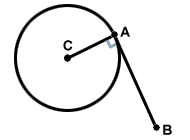
1. A tangent like is perpendicular to the radius drawn to the point of conduct.

2. If a line is perpendicular to a radius at its outer endpoint, then it is tangent to the circle.


A tangent segment is the part of a tangent line between the point of contact and a point outside the circle.

Line AB is the tangent segment.

A secant segment is the part of a secant line that joins a point outside the circle to the farther intersection point of the secant and the circle. The external part of a secant segment is the part of the secant


Two-Tangent Therom: If two tangent segments are drawn to a circle from an external point, then those segments are congruent.


Tangent Circles:  Circles that intersect each o ther at one point.

Circles can either be internally tangent or externally tangent.

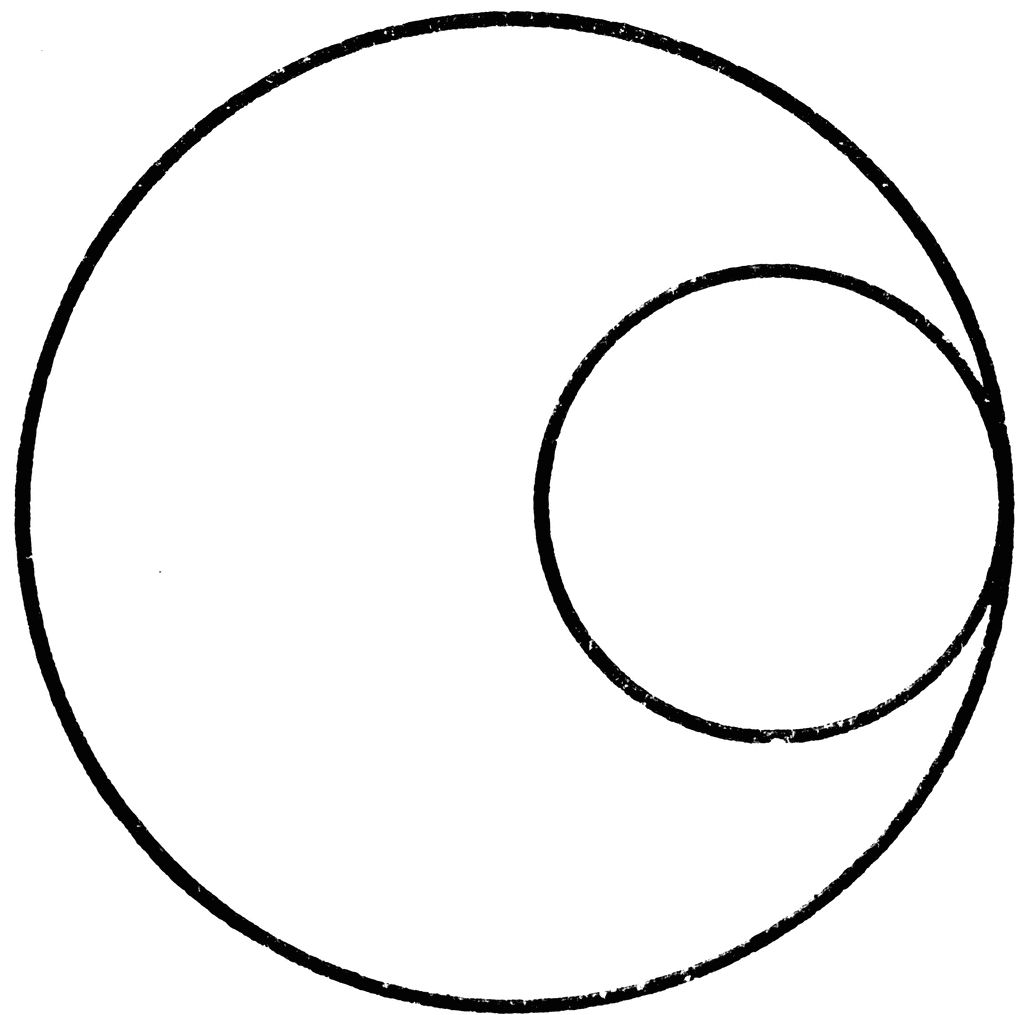
Internally tangent: one of the tangent circles liew within the other.


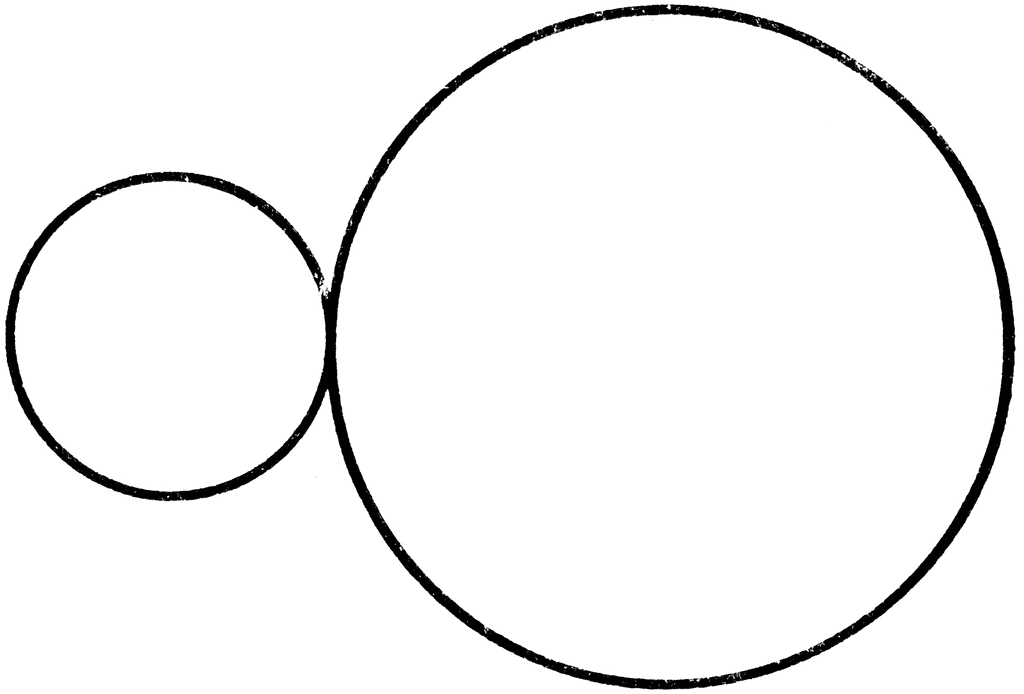
Externally tangent: each of the tangent circles lie outside each other.


Commmon tangent: A line tangent to two circles( not always the same point)
Common Internal tangent: A tangent like that lies between the two circles(intersects the segment joining the centers)
Common External tangent: A tangent that is not between the two circles (does not intersect the segment joining the centers)


Enjoy your day off:)
-Quigley

Saturday, February 26, 2011

QUIZ

Mr. Wilhelm-

Hi! I was just wondering when I should plan on taking the quiz. I heard that some people were taking it on Wednesday, before school. Thanks!

Jessica

Wednesday, February 16, 2011

10.3

Hello, friends!
We've gone through the entire class for blogs, so logically it must be my duty to once again do the first blog post.

Today we learned a couple of things.
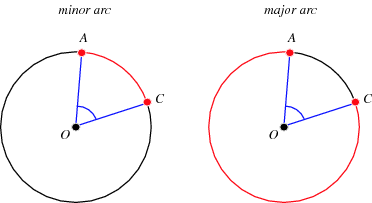
1) there are 3 types of arcs


     a) semicircles- 180 degree arcs (requires 3 points to name and identify)

     b) major arcs- greater than 180 degrees (requires 3 points to name and identify)
     c) minor arcs- less than 180 degrees (requires 2 points to name and identify)


2) Congruent arcs on different circles implies that the circles are congruent.
     a) to be congruent, both the angle measure and the length must be the same.

3) Congruent chords implies congruent arcs which implies congruent central angles which implies congruent chords. Basically, if you have a congruent Chord, you can prove the other two (central angles and arcs) congruent. If you have one you can prove the other two. They're biconditional.

Alright, gang. I'm off  for Orlando. Be good for Mr. Wilhelm and do 10 nice things a day for the next couple days till break. It'll make you feel good.
Shane McPartlin.
P.S.

                     March 6th.                                                                Get pumped.

Tuesday, February 15, 2011

Circles YAY!


Today we learned about circles. And just pointing out that i was the last to post both Trimesters so ha.

A Circle is the set of all points in a plane that are a given distance form a given point in the plane.  The given point is the center of the circle, and the given distance is the radius.

A chord is a segment joining any two points of a circle.  The diameter is the longest chord, and is twice the radius.  A secant line goes through two points on the circle.  A tangent lines intercepts a circle at exactly one point(the point of tangency)  


This is an externally tangent circle.                            These circles
                                                                              are internally tangent.

These are concentric circles. 


There were many theorems that we learned, they were...
-If a radius is perpendicular to a chord, then it bisects the chord.
-If a radius of a circle bisects a chord that is not a diameter, then it is perpendicular to that chord.
-The perpendicular bisector of a chord passes through the center of the circle.   


We also found that you can find the center of a circle, when you aren't given a complete circle by drawing chords.  And then using those silly compasses. 


In 10.2 we learned about congruent chords.  We learned two theorems.
-If two chords of a circle are equidistant from the center, then they are congruent.
-If two chords of a circle are congruent, then they are equidistant form the center of the circle. 


If AB≅ CD then GM≅EM
If GM≅EM then AB≅CD


Click Here for more information. 


I bet you just all lost didn't you?


Happy blogging
-Jennifer Kendall.

Wednesday, February 9, 2011

12.5/12.6 Volumes of Pyramids, Cones, and Spheres


Today in class we learned about the formulas to solve for the volumes of pyramids, cones, and spheres. These formulas came from sections 12.5 and 12.6 in our book.


12.5- Volumes of Pyramids and Cones


Pyramid....


The volume of a pyramid =1/3Bh...where B stands for the area of the base and h stands for height


So, in this picture, let's say the height =8 and the area of the base is 48. To solve for the volume, you use the formula....V=1/3Bh....V=1/3(48)(8).....V=1/3(384)....so V=128


Cones


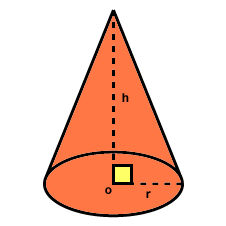
The formula to find the area of a cone = 1/3Bh which in this case =1/3πr^2h where r stands for radius length and h stnds for height.


In this picture of a cone, let's say the height is 7 and the radius is 3. With this information we can find the volume of the cone using the formula..... V=1/3πr^2h....V= 1/3(9π)(7)...V=1/3(63π)...V=21π

12.6


Volumes of Spheres


The volume of a sphere =4/3 πr^3 where r is the radius.
In this diagram, we will say the radius is 6 so we can use the formula for the volume of a sphere to find its volume....V=4/3 πr^3...V=4/3(216π)...V=288π

Well, that's about all we learned today in class from 12.5/12.6. Hope it helped. And here's a video and a math problem that helps us learn how to count to 12, which I think is very important to today's lesson.


*12 = http://www.youtube.com/watch?v=3nG1ckY7thw
Thanks, Michael
2/9/11